Earlier this year, I was asked to create a branded website for something that didn’t exist yet: Petrosino, an upcoming AI-animated series built around The Greatest Crime Story Never Told.
Based on the true story of NYPD Lieutenant Joseph Petrosino, the series explores a forgotten chapter of American history—one detective’s fight against organized crime during a time when the Black Hand terrorized immigrant communities in New York City.
It was one of the most rewarding projects of my career. The creative freedom was extraordinary, the historical material was fascinating, and the opportunity to experiment with AI opened doors I might never have explored on my own.
This is the story of how the website came together, the thinking behind its design, and how AI became a creative partner in bringing a lost American story into the digital world.
Explore the finished website: petrosino.tv

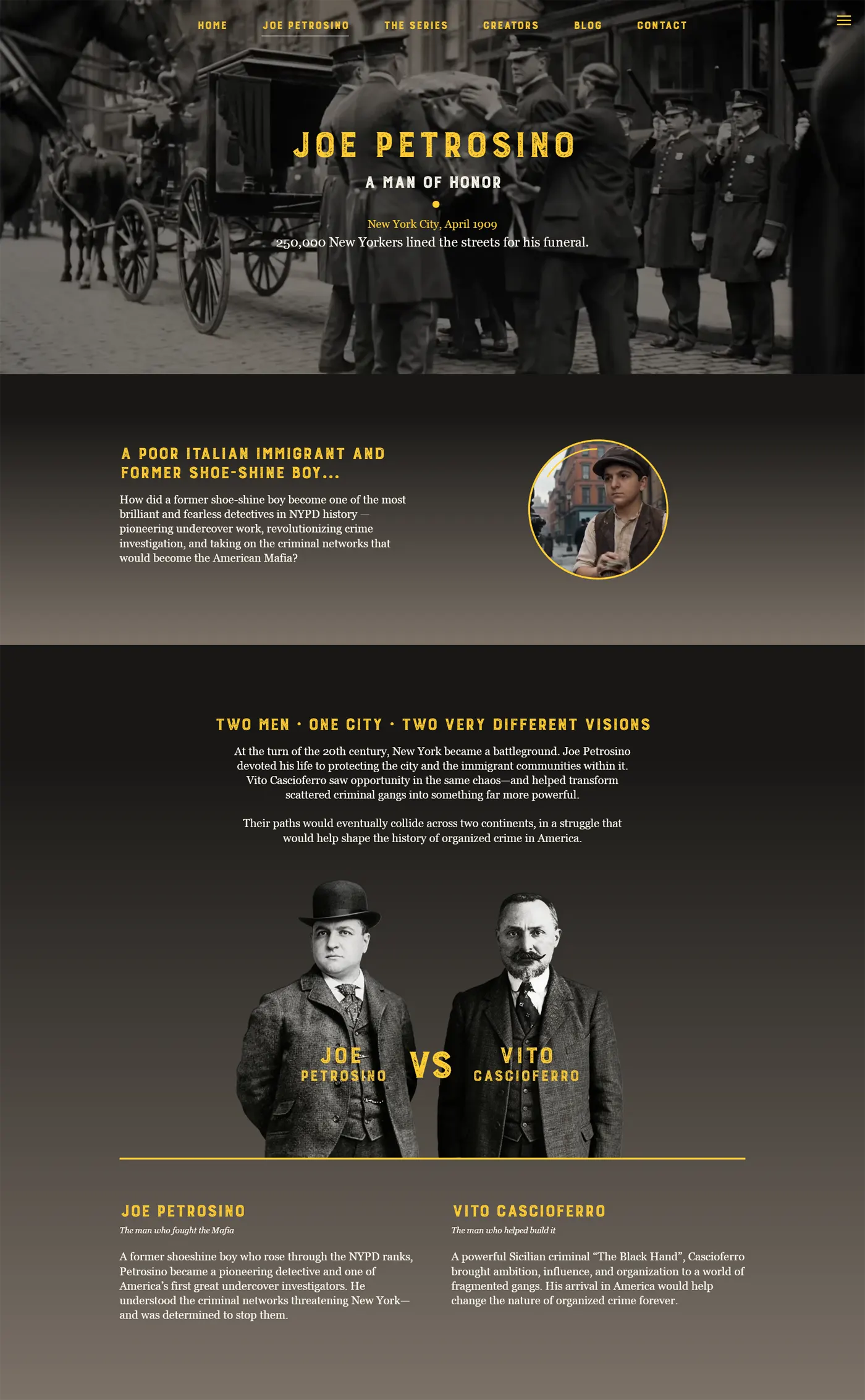
The Petrosino website homepage, featuring the cinematic opening and series tagline.
Who Was Joe Petrosino?
Before talking about design, it’s worth understanding more about the man at the center of the project.
Giuseppe “Joe” Petrosino was born in Padula, Italy, in 1860. He immigrated to the United States with his family as a boy, arriving in a country where Italian immigrants faced prejudice, difficult working conditions, and growing threats from criminal organizations.
In 1883, he joined the New York City Police Department. Italian-speaking officers were rare then, and Petrosino’s language skills, determination, and knowledge of immigrant communities soon made him an invaluable investigator.
His career took a significant turn in 1895, when Theodore Roosevelt, then president of the New York City Board of Police Commissioners, promoted him to detective sergeant. Roosevelt recognized Petrosino’s abilities, and the two developed a professional relationship built on mutual respect.
Petrosino became known for his undercover work, disguises, and relentless pursuit of criminals who exploited their own immigrant communities. His principal adversaries included the Black Hand, a name associated with extortion schemes and organized criminal networks targeting Italian Americans.
By 1908, Petrosino was a lieutenant commanding the NYPD’s Italian Squad—a specialized unit created to investigate organized crime linked to Italy.
His work eventually took him across the Atlantic.
In early 1909, Petrosino traveled to Sicily on a secret investigative mission to gather information about suspected criminals operating between Italy and the United States. On March 12, 1909, he was assassinated in Piazza Marina in Palermo.
His murder shocked both sides of the Atlantic. Vito Cascio Ferro, a Sicilian crime boss whom Petrosino had investigated, became a leading suspect, but no one was convicted of Petrosino’s killing.
His body was returned to New York, where an enormous crowd gathered to mourn him. Funeral crowd estimates reached about 200,000 to 250,000 people.
More than a century later, his story remains compelling: a determined detective who crossed borders to confront a criminal network, only to be killed on the very ground where his investigation led him.
It is a story of courage, ambition, immigration, and the price of pursuing justice.
And it deserves to be remembered.

Homepage collage: Joseph Petrosino, the NYPD lieutenant vs. Vito Cascioferro, “The Black Hand.”
A Series About the Real Godfather Saga
The website was created for Petrosino, an independent, AI-animated, half-hour serialized drama from San Andreas Films, driven by author, screenwriter, and director James Dalessandro and brought to life through the filmmaking vision of acclaimed Canadian filmmaker Robert Gaudette. A recognized voice in AI filmmaking, Robert has earned honors at international film festivals, including the 2026 Runway AI Festival and the New York International Film Awards. Together, their creative work brings a remarkable chapter of American history to the screen.
The series transforms Petrosino’s real cases and historical circumstances into dramatic stories. Its creators describe it as the real Godfather saga, told from the perspective of the man who almost stopped them.
The historical setting offers extraordinary material: the Black Hand, the struggle against organized crime, Petrosino’s relationship with Theodore Roosevelt, and the complex connections between New York and Sicily at the turn of the twentieth century.
Yet this is a story many people have never encountered.
That presented an interesting challenge. How do you introduce a historical figure, set the era’s atmosphere, communicate the ambition of an upcoming series, and make people want to discover more—all before the audience has seen an episode?
The website had to do more than provide information. It had to create anticipation.
The Brief: Total Creative Freedom
I’ve been designing and building websites since 1998. Over the years, I’ve worked with businesses, technology companies, nonprofits, and creative organizations, helping them translate their ideas into digital experiences.
My approach has always been personal and hands-on. I don’t start with a template and try to fit a client’s identity into it. I begin by listening, understanding the project, and finding a visual direction that feels right for that particular story or brand.
Every design decision should serve a purpose.
Petrosino was a different kind of brief.
There was no conventional product to sell, no catalog of services to explain, and no established audience expecting a familiar corporate website. There was a historical story, a creative team with a vision, and a client, James Dalessandro, who gave me an unusually open canvas.
The only essential requirement was that the website had to feel true to the series.
That freedom allowed me to approach the project less as a conventional website and more as an extension of the storytelling itself.
The Design Approach: A Website That Tells a Story
I treated the website as the first chapter of the series—a place where visitors could enter Petrosino’s world before watching the show.
Rather than simply presenting information, I wanted the experience to unfold gradually, revealing the characters, historical context, and atmosphere as visitors explored the site.
1. Long-Form, Section-by-Section Storytelling
The main pages are organized into carefully considered sections. Each one contributes another piece of the narrative, allowing visitors to discover the story at their own pace.
The goal was to create a natural progression: introduce the world, establish the historical context, meet the detective, and reveal the conflict that shaped his life.
This approach gives the content room to breathe. Instead of confronting visitors with a wall of information, the website guides them through a sequence of visual and narrative moments.
The structure also makes the experience accessible to different audiences. Someone arriving out of curiosity can quickly grasp the premise, while a history enthusiast can spend more time exploring the details.
2. Atmosphere First
I wanted visitors to feel the time and place as soon as the homepage appeared.
The colors, textures, typography, and imagery were selected to evoke New York at the turn of the twentieth century—a city transforming at extraordinary speed, filled with new arrivals, crowded streets, competing ambitions, and an undercurrent of danger.
I wasn’t interested in simply decorating a modern website with vintage photographs. The historical atmosphere had to inform the entire visual language.
I wanted the site to feel as though it had a smell.
That might sound like an unusual design objective, but it captures something important about the work. The strongest visual experiences engage our imagination beyond what we can actually see. A photograph of an old street can suggest its noise, its movement, its dust, and the lives unfolding within it.
My job was to bring those impressions together into a coherent digital experience.
3. A Moving Opening
The homepage opens with a short video evoking New York in the 1890s.
The opening video places viewers on a late-night street: shadows stretch across empty cobblestones, the warm glow of an Italian café spills onto the sidewalk, and Joe lingers at the threshold, caught between darkness and light. Before any words appear, these details immerse visitors in the era, letting them feel the atmosphere rather than simply observe it.
This was an important decision because the opening establishes the emotional tone for everything that follows.
In a project about historical crime, atmosphere is not an accessory. It is part of the story.
10-second video establishing Petrosino’s world through motion, historical imagery, and atmosphere.
4. A Website That Grew With the Story
What began as a relatively small concept gradually developed into a broader digital platform.
The finished website brings together nine page types and content areas, including the core pages, supporting resources, and individual blog articles.
- Home: The cinematic introduction and the series tagline.
- Joe Petrosino: The detective’s biography, presented through the theme “A Man of Honor.”
- The Series: An introduction to the production and an initial look at the pilot.
- The Creators: Information about the people behind the project.
- Blog: News, background stories, and updates.
- Downloads: Press and media resources, including the logo, storyboard, and character artwork.
- Contact and Privacy: Essential information for visitors, media representatives, and collaborators.
- Individual articles: Dedicated pages that provide space for longer stories and future updates.
The result is more than a promotional landing page. It provides a foundation that can grow as the series develops, giving the creators a place to share new material and build an audience.

Working With AI: My Creative Partner
One of the most interesting aspects of this project was the opportunity to work with AI throughout the creative process.
I built the website independently, using AI tools as assistants for research, image restoration, visual development, and video production.
For a solo designer, this changed what was practical to attempt.
Research and Historical Accuracy
A project built around real people and historical events requires more than an attractive visual style. The details matter.
I used AI assistants to explore the historical timeline, investigate the people involved, and cross-check information against published sources.
AI can accelerate research and help identify useful connections, but it is not a substitute for verification. Historical accounts sometimes disagree, and a plausible-sounding answer is not necessarily a correct one.
The goal was to use these tools to work more efficiently, all while maintaining a clear distinction between documented history and its dramatic interpretation.
Restoring the Past
Historical photographs are among the most valuable visual resources for a project like this. They also present practical challenges: damage, fading, limited resolution, and the restrictions of working with century-old material.
AI-assisted restoration helped me repair and enhance selected images, making them more usable in a contemporary digital environment while retaining their historical character.
The intention was not to make the past look artificially perfect. It was to bring important details into view and allow the imagery to work effectively on modern screens.
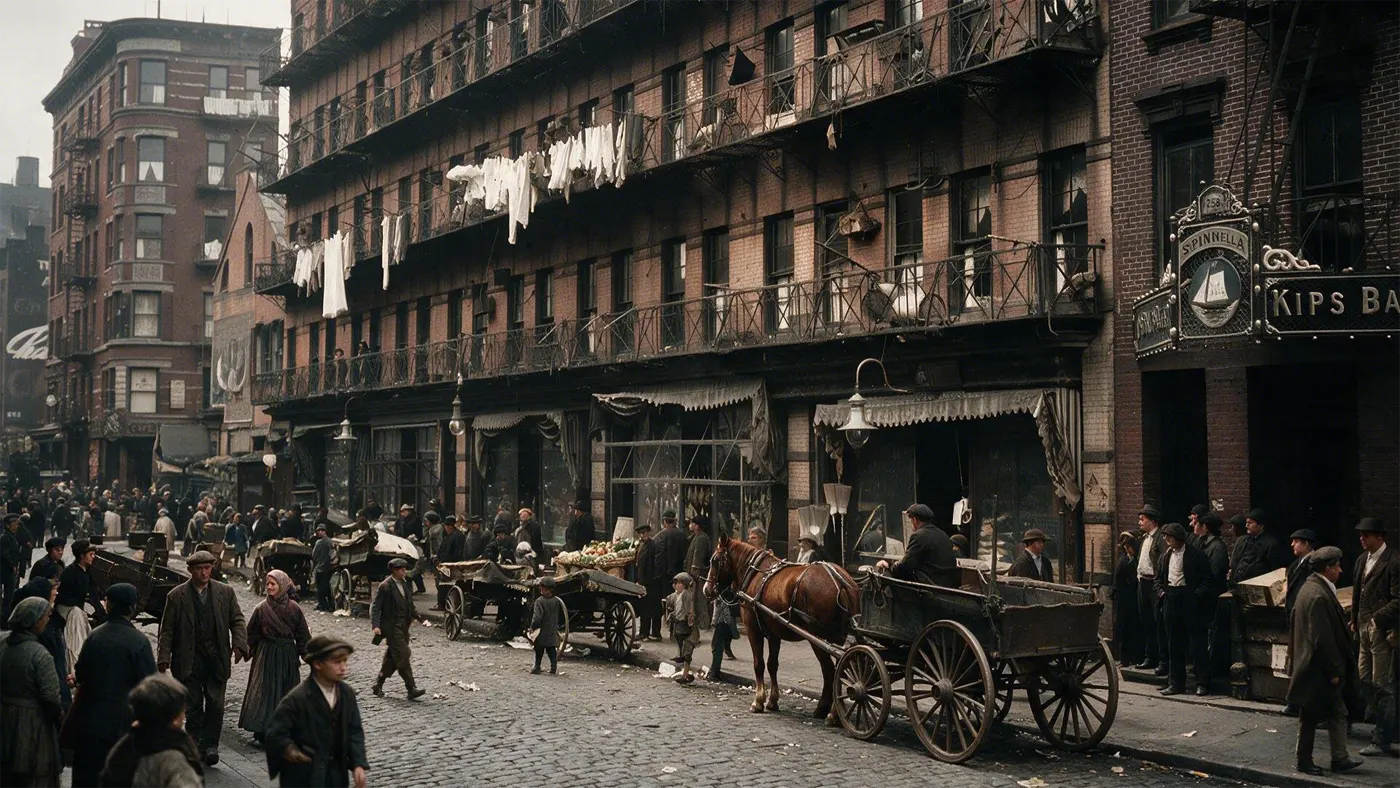
Restored historical photograph, New York City, circa 1990.
Creating a Richer Visual World
The opening video and many of the supporting visuals were created or enhanced with AI tools.
This was where the possibilities became especially exciting.
Reconstructing a convincing visual impression of historical New York would traditionally require substantial research, image sourcing, restoration, compositing, and production resources. AI made it possible to explore and develop visual material that would have been much more difficult for me to produce independently using conventional methods.
It also made experimentation more accessible. I could explore different visual directions, evaluate possibilities, and refine the material toward a consistent aesthetic.
I would not have attempted a project with this level of visual richness in quite the same way without these tools.
Where AI Stopped
For all its capabilities, AI did not determine the creative direction of the website.
It didn’t decide how the story should unfold, which visual moments deserved emphasis, how the pages should be structured, or what emotional experience the visitor should have.
Those decisions remained mine.
I selected the direction, evaluated the results, refined the imagery, developed the layouts, and brought the individual elements together into a cohesive experience.
I think of AI as a very capable assistant: one that can accelerate the work, expand the range of possibilities, and help a designer reach further.
But tools alone do not create a meaningful design.
The value comes from knowing what to make, why it matters, and how all the pieces should work together.
For me, this project was a practical demonstration of how AI can expand creative capability without replacing the designer’s judgment, experience, or responsibility for the final result.

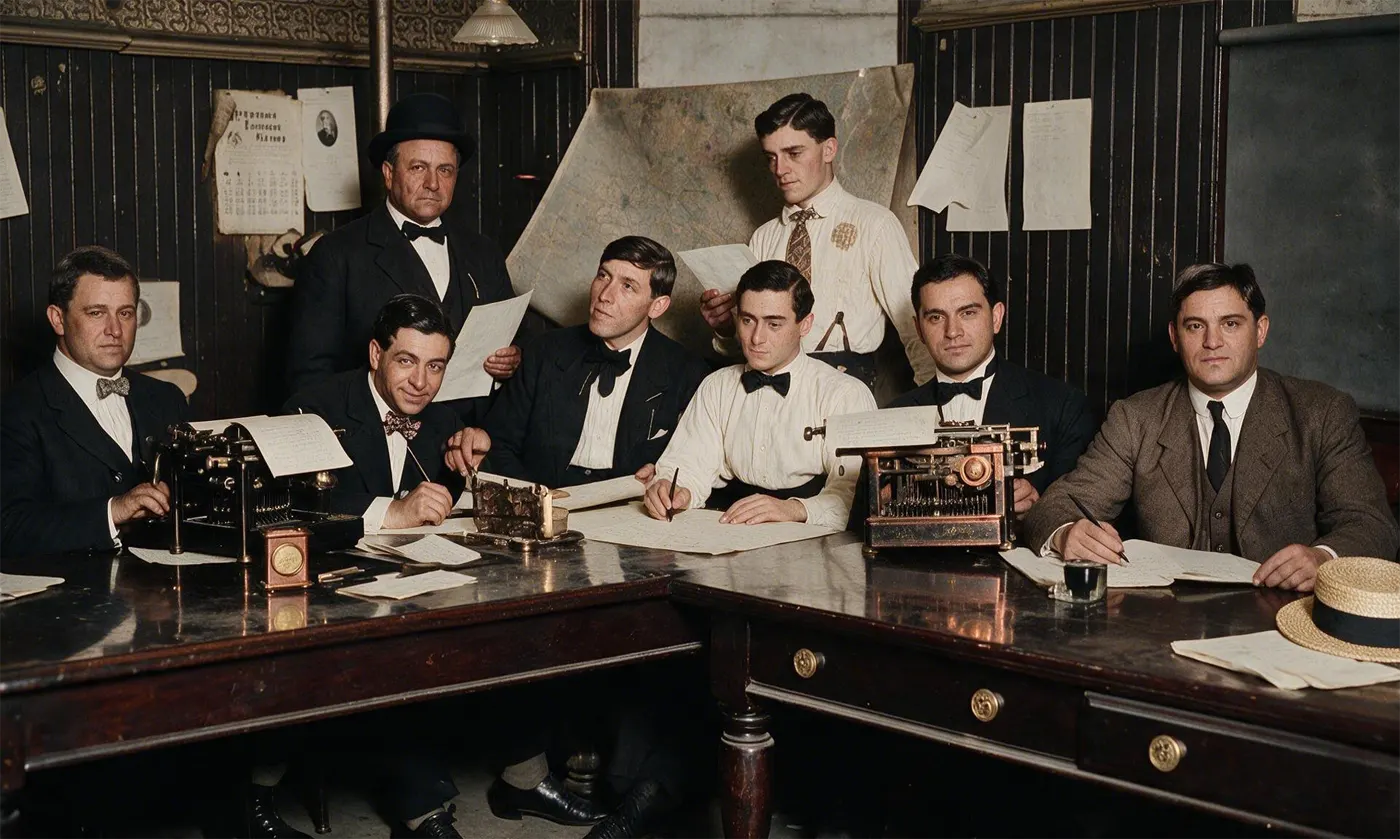
Restored photograph of the NYPD’s Italian Squad, developed for the series.
What I Learned
Looking back, Petrosino reinforced several ideas that have shaped my approach to design for many years.
A Website Can Exist Before the Show Does
Most entertainment websites support a production that audiences can already watch. Petrosino had to establish a world before the series was released.
That meant the website itself became part of the audience’s introduction to the project. It needed to communicate the premise, create curiosity, and give visitors a reason to return as the production progressed.
In that sense, the site wasn’t simply documenting a project. It was helping establish its identity.
Real History Deserves Care
AI makes it easier than ever to create convincing imagery and compelling narratives. That ability also brings responsibility.
When working with historical subjects, the distinction between authentic source material, restored photographs, AI-generated imagery, and dramatic interpretation matters.
Visual storytelling can make history more accessible, but it should not come at the expense of accuracy.
Story Is a Design Tool
The same principle I apply to a business website—that visitors should understand the message quickly and feel something about it—proved especially powerful here.
A strong digital experience does more than organize information. It establishes priorities, creates a rhythm, and guides people toward understanding.
For a business, that might mean communicating the value of a product or building confidence in a brand. For Petrosino, it meant introducing a forgotten historical figure and making his story feel immediate and relevant.
The subject changes. The underlying design challenge remains remarkably similar.
Constraints Can Become Creative Opportunities
Working independently meant I had to be thoughtful about time, resources, and production methods. AI helped me explore ideas and create assets that would otherwise have required a different scale of production.
But the most important lesson wasn’t about using a particular tool. It was about remaining open to new methods while keeping the creative objective in focus.
Technology is most useful when it enables a better idea—not when it becomes the idea itself.
A Digital World for a Story Worth Remembering
Petrosino brought together several things I love about my work: visual storytelling, historical research, thoughtful user experience, custom web design, and the opportunity to explore new technology.
It also reminded me why I have continued designing websites for nearly three decades—year after year.
Technology changes. Tools evolve. Expectations shift.
But I still believe that a website should have its own character, that every project deserves a considered approach, and that good design begins with understanding the story you need to tell.
The Petrosino series is coming soon. In the meantime, the website provides a first look at its world, the man who inspired it, and the creative team behind the story.
Explore the project at petrosino.tv
And if you’re working on a brand, product, or story that deserves something beyond a template, I’d love to hear about it.
At Artenergy, I bring together custom website design, user experience, visual storytelling, and development to create digital experiences shaped around the people and ideas behind them.
Let’s talk about your project at Artenergy.com

Co-founder of Artenergy